Buyer Side Domain Broker: How to Acquire a Domain That Spans Multiple Extensions and a Trademark
TL;DR
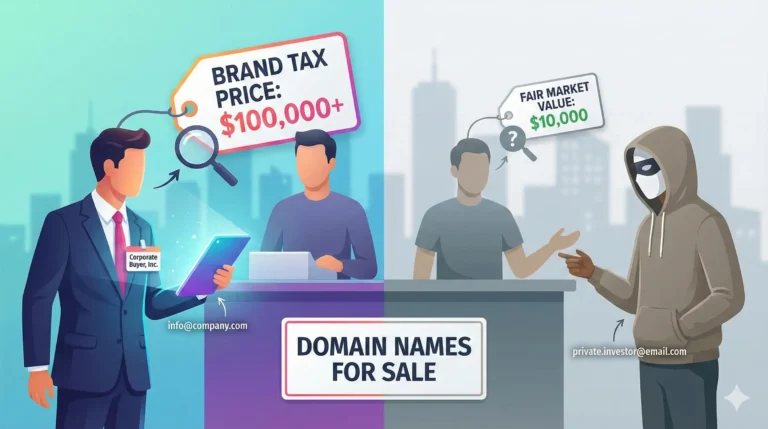
A buyer side domain broker acquires a domain on your behalf while keeping your identity hidden, so the seller prices it at market value — not against your budget.
When the target is a full brand, the deal covers every extension plus any registered trademark, not just the .com.
Domains may sit across multiple registrars; some transfer instantly, country-code extensions can take days.
A trademark transfers separately through an IP office filing and can take about a month.
One escrow settlement covers all assets: funds release only after you confirm receipt.
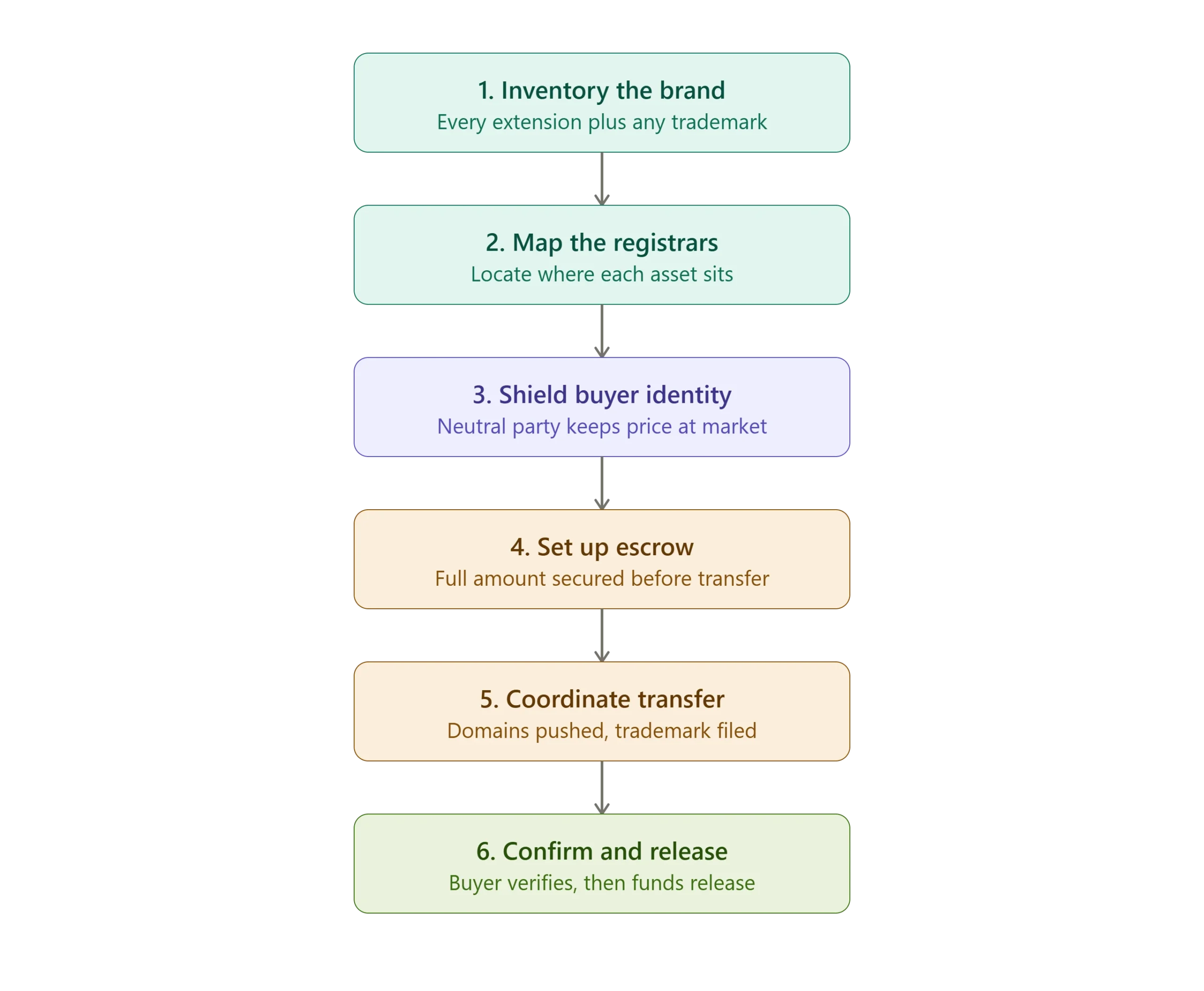
Hiring a buyer side domain broker makes sense the moment a domain acquisition stops being a single purchase. A serious brand name rarely lives on one domain — it spans the .com, its matching extensions, and sometimes a registered trademark, often scattered across different registrars and jurisdictions. Pursue it yourself from a corporate identity and the price inflates the instant the seller sees who’s asking. The broker’s role is to acquire the whole footprint quietly, anchor the price to the asset’s market value, and settle every piece in one transaction. Here’s what that process actually involves.
Why a single domain is rarely a single asset
A serious brand name isn’t one domain. It’s a cluster: the .com, often the .net and .org, the relevant country extensions, and occasionally a registered trademark.
Acquire only the .com and you leave the rest exposed. A speculator can grab the extensions you skipped the moment they sense a buyer is active. And if a trademark stays with the original owner, you may not hold clear rights to the name you just paid for. This is one of the most common ways domain purchases go wrong
The first job is an inventory: identify every extension tied to the name, and check whether a trademark is registered against it anywhere.
What a buyer side domain broker actually does
A buyer side domain broker represents the buyer only — never the seller. The distinction matters because a seller’s broker earns more when the price goes up, while a buyer side domain broker’s job is to keep your spend down and your identity concealed.
Buyer-side vs seller-side, at a glance
|
DIY outreach |
Buyer side domain broker |
|
|
Identity |
Exposed to seller |
Shielded |
|
Price basis |
Your perceived budget |
Asset market value |
|
Multi-asset deals |
Easy to fumble |
Coordinated as one |
|
Trademark transfer |
Often missed |
Handled as a filing |
The multi-registrar problem
Domains in one brand cluster are often spread across more than one registrar — a .com at one, a country-code extension at a specialist registrar elsewhere.
This matters because transfers behave differently by location. Domains held at the same registrar as your account usually move by registrar push: fast and free, no registrar change. Country-code extensions often transfer manually and take several business days. Domain ownership records themselves are governed by ICANN
This matters because transfers behave differently by location. Domains held at the same registrar as your account usually move by registrar push: fast and free, no registrar change. Country-code extensions often transfer manually and take several business days, because staff process them by hand.
A clean acquisition plans for these differences up front, so you aren’t left wondering why six names moved instantly and one is still pending. If an owner goes silent mid-process, that’s usually strategic — here’s why domain owners don’t respond
Where the trademark changes everything
If the name carries a registered trademark, the trademark transfers separately from the domains — through the intellectual property office of the country where it’s registered.
That has three consequences: a separate transfer fee set by the IP office, independent of domain prices; a filing with a processing time, often around a month, so legal ownership of the mark updates after the domains move; and visible ownership records, since regional IP offices draw from shared databases.
Skip the trademark step and you can own every domain and still not control the brand.
How escrow protects a multi-asset acquisition
With multiple domains across multiple registrars plus a trademark filing, your risk is paying and then receiving assets piecemeal — or not at all. A licensed escrow service removes that risk:
You deposit the full agreed amount into escrow. The seller sees the funds are secured but cannot touch them.
The seller pushes every domain to your accounts and initiates the trademark reassignment.
You confirm receipt of each asset.
Only then does escrow release the funds.
If the seller delivers the wrong asset or fails to deliver, your money stays protected. It’s the only safe way to settle a deal where value is spread across several assets and jurisdictions.
Why a buyer side domain broker keeps your identity hidden
Every step above can run without the seller learning who’s really buying. That’s price protection, not paranoia. The moment a seller knows a funded company is the buyer, the asking price climbs — they re-price against your budget instead of the asset’s worth. A neutral buyer side domain broker keeps the negotiation anchored to market value.
Can you buy a domain and its trademark in one transaction?
The domains and the trademark move through different mechanisms, but both can settle under a single escrow agreement, so you pay once and receive everything together.
How long does a multi-extension acquisition take?
The domains can move within minutes to a few business days depending on registrar and extension. If a trademark is involved, full legal reassignment can take roughly a month due to IP office processing.
Why use a buyer side domain broker instead of emailing the owner yourself?
Contacting an owner from a corporate identity typically inflates the asking price, because the seller prices against your budget. A buyer side domain broker keeps you anonymous and the price grounded in market value.
Does the seller find out who is buying?
Not if the acquisition runs through a neutral representative. Your identity can stay shielded through negotiation and transfer, then disclosed only after terms are locked — or not at all.