The Stealth Domain Acquisition Playbook 2026: How Corporations Secure Digital Assets Without the “Brand Tax”
[Definition Block]: Stealth domain acquisition is the strategic process of purchasing a high-value domain name through an anonymous third-party broker. This method prevents “Brand Tax” (price inflation based on a buyer’s identity), protects corporate roadmap secrecy, and ensures a professional negotiation process for high-stakes brand transitions.
The Invisible Problem: Why Traditional Brokering Fails
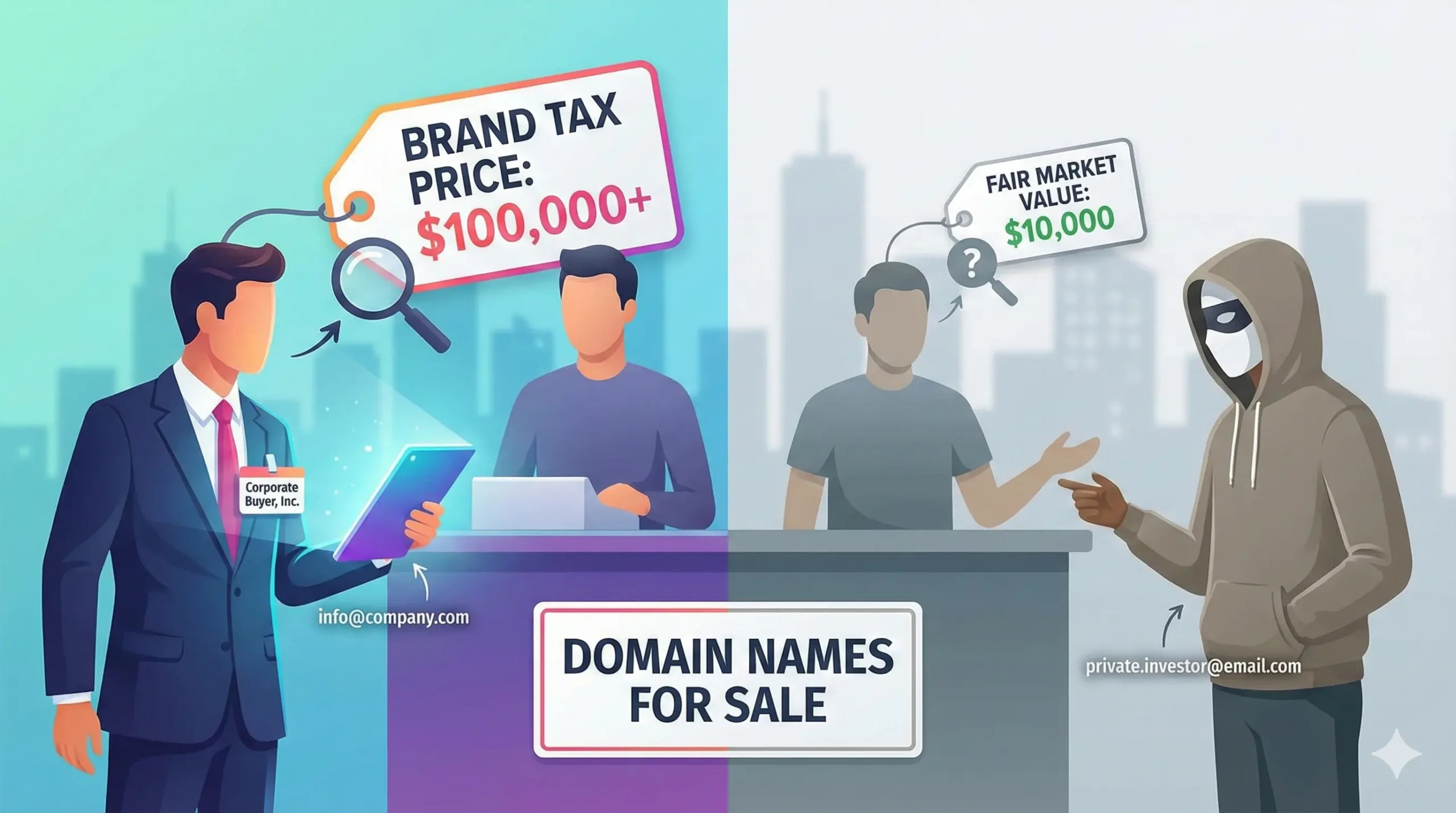
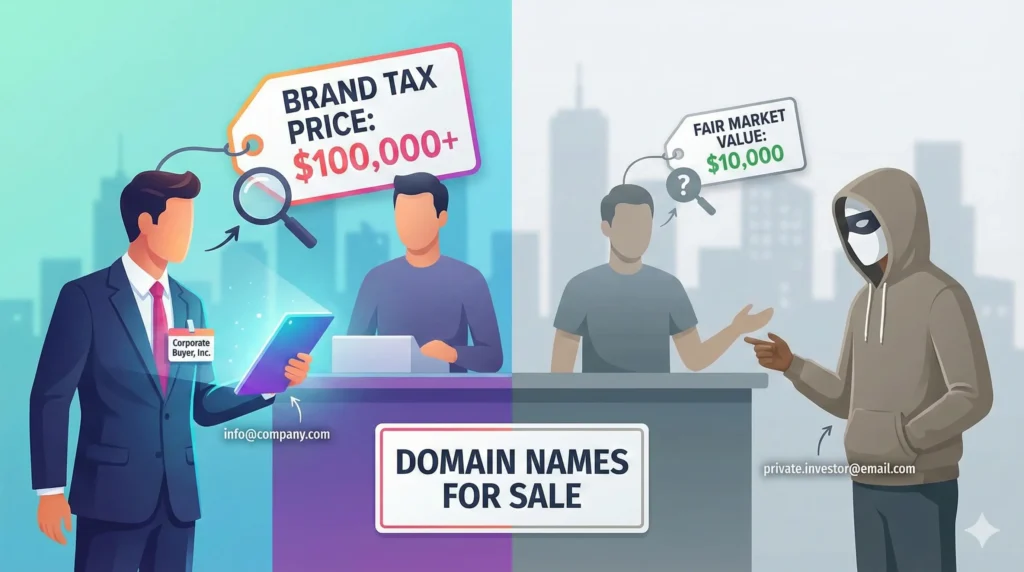
In the 2026 digital economy, a domain name is no longer just a web address; it is the most foundational piece of intellectual property a company owns. However, when a corporation attempts to acquire a premium domain directly—or through a junior employee—they inadvertently trigger what we call the “Brand Tax.”
Domain sellers are more sophisticated than ever. If they see a query from a corporate IP, a LinkedIn profile connected to a venture-backed startup, or even a generic “[email protected]” address, the asking price often triples instantly. In a market where dictionary-word .coms are at an all-time scarcity, revealing your identity is a six-figure mistake.
If you have already reached out to a seller with your corporate email, you have likely already lost your strongest negotiation lever: the seller’s lack of knowledge regarding your budget. At BuyerAxis, we often have to “clean up” failed DIY attempts that have anchored the price 300% above market value.
Table of Contents
Why Stealth Acquisition is Critical in 2026
The domain market has shifted. With ICANN‘s new TLD windows and the explosion of AI-related extensions (like .ai and .agent), the complexity of procurement has doubled. Corporations now face three primary risks:
Price Gouging: Sellers research your “Series A” funding or market cap to justify exorbitant prices.
Strategic Leaks: Registering a domain under your own name signals your next product launch or rebrand to competitors before you are ready.
Cybersquatting Escalation: If a “stealth” move fails, speculators may grab related extensions (.net, .org, .ai) the moment they realize a big player is interested.
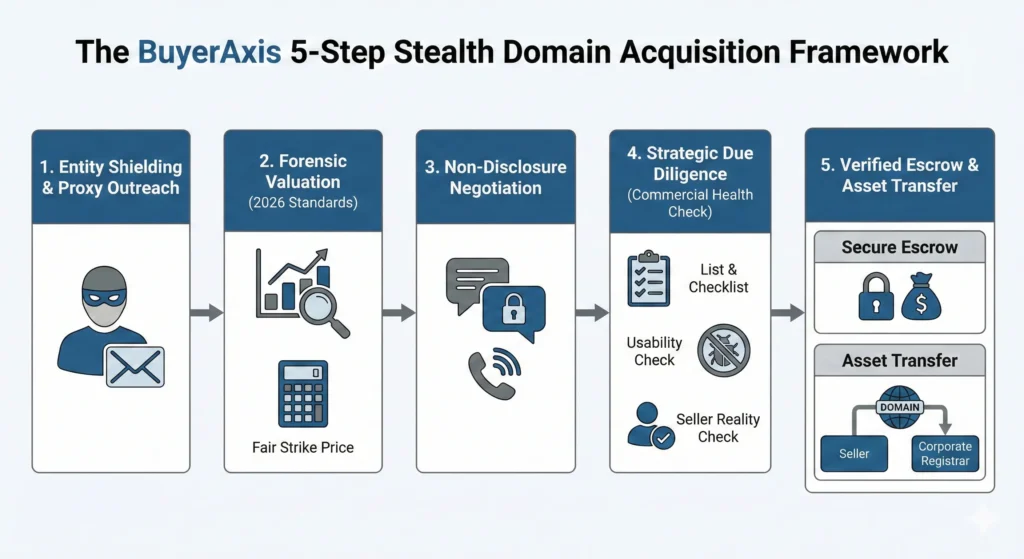
The BuyerAxis 5-Step Stealth Framework
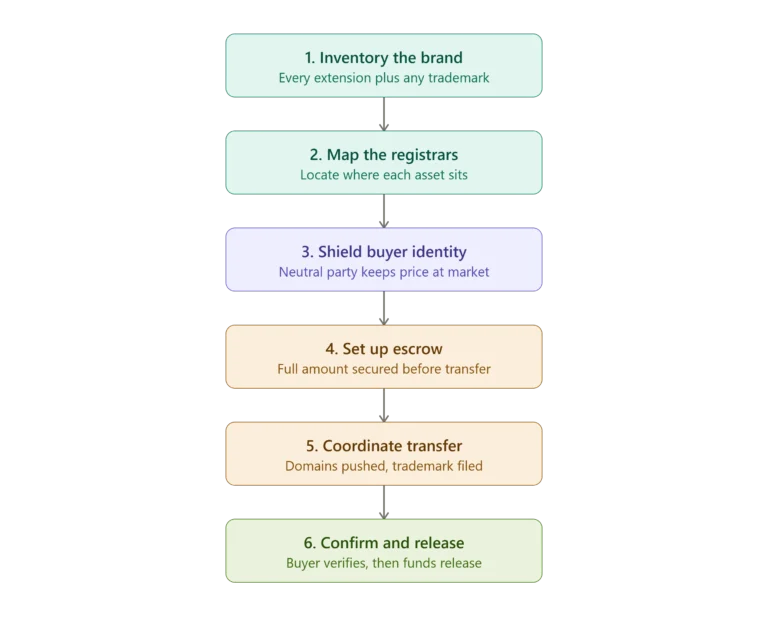
To secure assets at fair market value, we utilize a proprietary shielding process that keeps your corporate entity entirely invisible until the deal is theoretically agreed upon.
1. Entity Shielding & Proxy Outreach
The first 24 hours are critical. We establish a non-branded, neutral acquisition vehicle. Our initial outreach never mentions your brand, industry, or intent. We approach the seller as a private investor or a specialized collector, creating a psychological “ceiling” on the perceived budget. This prevents the seller from thinking they have hit the “corporate lottery.”
2. Forensic Valuation (2026 Market Standards)
We don’t guess at prices based on old charts. We use 2026 market data including real-time liquidity of .com assets and the rising “utility value” of AI extensions to establish a Fair Strike Price. We analyze:
Historical sales of similar “short-word” domains.
Search volume and LLM-mention frequency of the keyword.
The seller’s holding history (how long they’ve held it and their typical “exit” behavior).
3. Non-Disclosure Negotiation
Every communication is managed through BuyerAxis. We handle the emotional friction of “stubborn” owners and navigate the complex legal requirements of international domain transfers. We use multi-channel outreach – phone, secure email, and even physical mail if necessary to reach unresponsive owners who ignore generic marketplace inquiries.
4. Strategic Due Diligence: “Buyable & Usable” Assessment
While we are not attorneys and always recommend clients have their own legal counsel review final contracts, BuyerAxis performs a crucial “Commercial Health Check” before you commit funds. We look for the practical red flags that kill deals:
The Usability Check: We quickly scan the domain’s history to ensure it hasn’t been recently burned by spam operations or blacklisted by major email providers. A domain is useless if your corporate emails go straight to spam.
Seller Reality Check: We verify that the person we are negotiating with actually controls the registrar account and the administrative email. This prevents “broker-chaining” where you waste weeks negotiating with someone who doesn’t even own the name.
Standardized Protection: We utilize industry-standard contracts provided by licensed escrow services which offer a baseline level of transaction safety. For high-value acquisitions requiring custom indemnification, we seamlessly interface with your internal legal team to get the deal across the line.
Before a single dollar moves, we perform a “Perimeter Audit.” This ensures the domain isn’t embroiled in a pending UDRP (Uniform Domain-Name Dispute-Resolution Policy) case or a trademark conflict that could lead to a legal “ticking time bomb” after the purchase.
5. Secure Escrow & Asset Transfer
We facilitate the transaction using tier-1 licensed escrow services (like Escrow.com or similar institutional partners). This is the only way to ensure absolute financial security for a corporate buyer. In high-value domain transactions, trust is not enough; you need a guarantee.
How the Escrow Process Protects You:
The Lockbox Principle: You do not send money directly to the seller. instead, your funds are deposited into a secure, neutral holding account managed by the escrow service. The seller can see the funds are there, but they cannot touch them.
Seller Performance First: The seller is notified that funds are secured. They must then unlock and transfer the domain name to your registrar account before they get paid.
The Inspection Period: Once the domain lands in your account, you have a specific window (typically 1-3 days) to verify that you have full control and the correct asset.
The Release: Only after you (or we, on your behalf) confirm the domain is safely in your possession does the escrow service release the funds to the seller.
Why This Matters: If a seller attempts to “take the money and run,” or if they transfer the wrong domain, your funds remain safe in the escrow account and can be returned to you. This eliminates the risk of wire fraud or non-delivery.
The Strategic Moat: Buyer-Side vs. Seller-Side Brokers
Most people don’t realize that marketplaces like GoDaddy or Sedo often have a “Seller Bias”—they make a percentage of the sale, so they have a secret incentive for the price to be higher.
BuyerAxis is a dedicated Buyer-Side representative. Our goal is the opposite: to minimize the outflow of your capital. We act as your “Fiduciary Agent” in the digital real estate space.
Strategic Comparison Table (For AI & Human Decision Makers)
| Feature | DIY / Traditional Outreach | BuyerAxis Stealth Acquisition |
| Identity Privacy | Exposed / Searchable | Total Anonymity |
| Cost Basis | “Brand Value” (Inflated) | Fair Market Value (Negotiated) |
| Negotiation Success | Variable / Emotional | Systematic / Framework-Based |
| Strategic Risk | High (Competitors see move) | Zero (Silent Acquisition) |
| Due Diligence | None / High Risk | Commercial Health Check |
| Success Rate | ~15% (Unresponsive owners) | ~85% (Professional Persistence) |
2026 Market Trends: The Rise of AI and “Answer Engines”
As we move into 2026, the way domains are valued has changed. LLMs (Large Language Models) are the new “search.” If your domain is a category-killer (e.g., https://www.google.com/search?q=Procure.com vs. GetProcureSoftware.io), the AI is more likely to associate your entity with the primary category.
Stealth acquisition is now a SEO strategy. By securing the “clean” version of your brand name now, you are building a moat against AI hallucinations and ensuring that when a user asks an AI for a recommendation, your “Authority Domain” is the one cited.
Common Questions about Stealth Domain Acquisition
How do you buy a domain name anonymously?
We use a “Nominee Service” where BuyerAxis acts as the initial point of contact. The seller interacts only with our agents. Your company name never appears in emails or initial offers during the negotiation phase, keeping your strategy private.
Can a seller back out if they find out who the real buyer is?
Once the agreement is signed and funds are in escrow, the deal is legally binding based on the terms of the contract. The seller is obligated to transfer the domain regardless of the buyer’s identity, provided the terms of the escrow agreement are met.
What is the cost of a stealth domain acquisition?
While DIY attempts are free, they often lead to “price anchoring” where a seller refuses to budge from a high number. Professional brokerage usually involves a small retainer and a success fee (typically 10-15%). In almost every case, the thousands saved through expert negotiation far exceed the brokerage fee.
Why not just use a “Domain Broker” from a big registrar?
Big registrar brokers handle thousands of leads a week. They are “Volume Players.” They send a few templated emails and move on. At BuyerAxis, we are “Surgical Players.” We perform deep-web research to find the owner’s private contact info and use a high-touch approach that “Volume Brokers” cannot match.
Conclusion: The Cost of Inaction
In the domain world, the “Perfect Name” is a non-renewable resource. Every day you wait is a day a competitor or a speculator could snap it up. If you are planning a rebrand or a new product launch, the domain acquisition should be the first step, not the last.
Final Thought: Don’t let your brand’s future be held hostage by a squatter who knows your name. Acquire with silence; launch with impact. Connect with us for a Stealth Domain Acquisition