
Why Domain Owners Don’t Respond: The Negotiation Mistake Founders Keep Making
Key Takeaways
Silence ≠ Hostility: Non-response is rarely a tactical “power move.” It usually signals inbox fatigue, unclear intent, or an owner who hasn’t yet defined the asset’s value.
The Time Horizon Mismatch: Conflict arises because founders think in fiscal quarters while domain owners often think in years or decades. Respecting this different “clock” is essential for engagement.
High Anchoring as Protection: Owners often quote “irrational” prices to protect their optionality in a vacuum of information. It’s a defensive posture, not necessarily a reflection of greed.
Pressure Triggers Defense: Using legal language or aggressive follow-ups reframes the conversation from a business deal to a defensive standoff, which almost always ends in a stalemate.
Precision Over Power: Success comes from reducing friction rather than applying force. Understanding the owner’s incentives allows for a quieter, more effective negotiation.
There’s a quiet tension that shows up whenever domains enter the conversation, especially when founders start asking why domain owners don’t respond to outreach or price discussions.
Founders feel it. Legal teams feel it. Even advisors feel it.
The assumption forms quickly: If someone owns the name we want and isn’t responding, or quotes a number that feels detached from reality, they must be hostile, greedy, or playing games.
That assumption usually makes things worse.
This misunderstanding sits at the heart of why domain owners don’t respond the way buyers expect them to.
Not because it’s morally wrong, but because it’s strategically inaccurate.

Table of Contents
Why domain owners don’t respond
Understanding why domain owners don’t respond requires looking at how differently they experience time, urgency, and risk. Silence is rarely personal.
Most domain owners are not running desks with inbox triage and response SLAs. Many are individuals or small operators holding long-term assets alongside unrelated work.
Non-response can mean:
The message didn’t reach the right inbox
The intent wasn’t clear
The timing wasn’t right
The owner hasn’t decided what the asset means to them yet
Silence often reflects uncertainty, not refusal. This is why domain owners don’t respond quickly or clearly in early conversations. They’re often still deciding what the asset represents to them.
Treating it as hostility creates pressure where patience would work better.
Why prices feel irrational
From the outside, domain pricing looks arbitrary. This pricing confusion is closely related to why domain owners don’t respond predictably when buyers lead with assumptions instead of context.
From the inside, it usually isn’t.
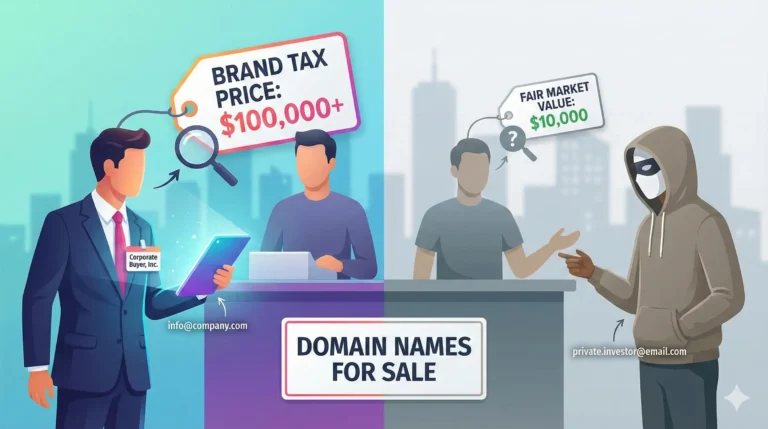
Owners price based on asymmetry. They don’t know who you are, what your urgency is, or what alternatives you have. In that vacuum, they anchor high to protect optionality.
To them, the domain is a fixed asset with no carrying pressure beyond renewals. To a company, the domain is contextual. Its value changes with timing, funding, and visibility.
When those two perspectives collide, the number feels disconnected.
It’s not irrational. It’s incomplete.
Why pressure backfires
Pressure reveals more than it accomplishes.
Aggressive follow-ups, legal language, or implied urgency tend to collapse optionality. They signal that the buyer’s need has outpaced their leverage.
Once that signal is sent, the negotiation stops being about alignment and starts being about endurance.
Most owners aren’t trying to extract maximum value at all costs. But they will protect themselves when they feel pushed.
Pressure reframes the interaction from discussion to defense.
And defense rarely leads to reasonable outcomes. In practice, this is one of the most common domain negotiation mistakes founders make when they misunderstand why domain owners don’t respond.
The real mismatch
Most failed domain conversations don’t break because of greed or bad intent.
They break because both sides are operating under different clocks.
The owner is thinking in years.
The company is thinking in quarters.
Until that mismatch is acknowledged, every interaction feels tense.
Understanding that doesn’t guarantee a deal.
But it does remove unnecessary friction.
And friction, more than price, is what kills most negotiations before they even start.
Domain owners aren’t obstacles to overcome.
They’re counterparts operating under a different set of incentives. Once you understand why domain owners don’t respond the way you expect, negotiations become quieter, slower, and far more effective.
Recognizing that doesn’t make you softer.
It makes you more precise.
FAQ
Why do domain owners not respond to emails?
In most cases, silence reflects uncertainty, not hostility. Understanding why domain owners don’t respond means recognizing that many are individuals holding long-term assets, not sales teams.
Are domain owners intentionally ignoring buyers?
Usually not. Domain owners don’t respond when intent is unclear, timing is wrong, or they haven’t decided what role the domain plays in their long-term plans.
Why do domain owners quote prices that feel unreasonable?
Because pricing protects optionality. What feels expensive to a buyer may simply reflect asymmetry and risk from the owner’s perspective.
What is the biggest mistake founders make when negotiating domains?
One of the biggest domain negotiation mistakes is applying pressure too early. It often backfires once owners sense urgency.
How should founders approach domain negotiations more effectively?
By slowing down, clarifying intent, and respecting that domain owners operate on longer time horizons than startups.
Can understanding why domain owners don’t respond improve deal outcomes?
Yes. Recognizing these dynamics reduces friction and prevents negotiations from collapsing before they begin.