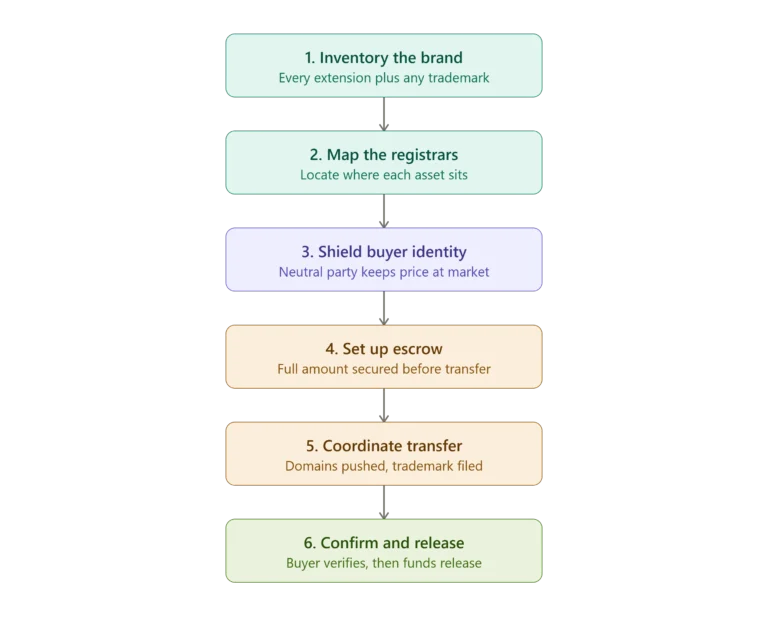

What a Clean Domain Acquisition Actually Looks Like
Key Takeaways
The “Uneventful” Goal: A successful domain acquisition should feel boring and routine, not dramatic or urgent.
Internal Assessment First: Never engage an owner until you have determined if the domain is a functional necessity or merely a “nice-to-have” luxury.
Silence as Leverage: Speed is the enemy of leverage. A clean process prioritizes quiet containment over rapid closure to prevent price inflation.
Walking Away is a Win: A “clean” acquisition process views a non-deal as a successful resolution if the terms create long-term business drag.
Decouple Ego from Identity: Avoid letting a domain become a proxy for company ambition; keep the transaction grounded in operational utility.
Most people imagine a domain acquisition as a transaction.
Find the owner. Agree on a price. Transfer the name. Move on.
That mental model is exactly why so many domain purchases become expensive, political, and quietly damaging.
A clean domain acquisition process doesn’t feel dramatic. It doesn’t trigger internal urgency. It doesn’t leave behind explanations, justifications, or post-mortems.
When it works, it feels almost uneventful.
That’s not an accident. It’s structure.

Table of Contents
Why Most Domain Acquisitions Go Sideways
Domain acquisitions usually fail long before any money changes hands.
They fail when urgency is introduced too early. They fail when intent leaks before strategy is clear. They fail when teams confuse action with progress.
The irony is that most of these failures happen in well-run companies. Fast-moving teams. Smart founders. Capable legal counsel.
This pattern shows up repeatedly in why most domain purchases go wrong, where early assumptions turn routine acquisitions into unnecessary problems.
The problem isn’t competence. It’s framing.
When a domain acquisition is treated as a simple purchase, pressure accumulates quickly. Timelines appear. Stakes inflate. The domain starts to feel larger than it is.
A clean domain acquisition process prevents that expansion from happening in the first place.
Step One: Assessment Before Engagement
Every clean acquisition starts with a pause.
Not to negotiate. To assess.
Does the domain materially affect the business today? Is the risk operational, reputational, or hypothetical? What actually changes if nothing is done this quarter? What changes if nothing is done for a year?
This stage is deliberately internal. No outreach. No signals. No assumptions about price or availability.
The goal is to determine whether the problem is real or simply uncomfortable.
Many domains feel urgent because they’re visible, not because they’re dangerous.
A disciplined acquisition process allows for the possibility that no acquisition is required at all. That option alone preserves leverage.
Step Two: Strategy Without Exposure
If engagement makes sense, the next phase is internal alignment.
Not alignment around how to get the domain, but around what matters.
Who communicates and who doesn’t.
What information is acceptable to reveal and what is not.
What outcomes are viable.
What outcomes are unacceptable, even if the domain is attractive.
This is where most acquisitions quietly break down.
Teams rush to outreach before agreeing on constraints. Budget expectations float. Timelines leak. Internal disagreements surface externally.
A clean acquisition process treats optionality as an asset. Strategy exists to protect it.
Nothing moves fast at this stage. That’s intentional.
Step Three: Quiet Execution
Clean execution is intentionally boring.
No public signaling. No aggressive follow-ups. No escalation that hasn’t been earned.
Communication stays narrow. Tone stays neutral. Expectations remain undefined.
Most clean acquisitions don’t feel like negotiations while they’re happening. They feel like conversations that may or may not continue.
That ambiguity is doing real work.
It allows the owner to evaluate the asset without pressure. It prevents the buyer from revealing urgency. It keeps the domain from becoming symbolic inside the organization.
A disciplined domain acquisition process avoids turning the name into a referendum on competence, ambition, or legitimacy.
Why Speed Is Usually the Enemy
Speed feels responsible. It feels decisive. It creates the illusion of control.
In domain acquisitions, speed is often the most expensive input.
The faster a team pushes, the more information it reveals. Internal deadlines surface. Dependency becomes visible. The domain stops being an asset and starts being a solution to someone else’s problem.
Once that happens, leverage collapses.
A clean domain acquisition process prioritizes containment over closure. It resists the urge to “just get this done” in favor of keeping future options intact.
This restraint is uncomfortable. That’s the point.
Step Four: Closure or Walk-Away
Eventually, clarity emerges.
Sometimes it’s a price that aligns. Sometimes it’s a number that doesn’t. Sometimes it’s no response at all.
A clean process accepts all three outcomes without escalation.
Walking away is not a failure. It’s a resolution.
It preserves leverage. It protects focus. It prevents sunk costs from forming narratives that are hard to unwind later.
The most damaging acquisitions aren’t the ones that don’t close. They’re the ones that close under pressure and then require years of justification.
A clean domain acquisition process ends with fewer open loops than it began with.
What Clean Acquisitions Deliberately Exclude
There are no guaranteed timelines. No artificial deadlines. No promises of success.
Those things feel comforting, but they distort behavior.
Clean acquisitions are defined by discipline, not certainty. They don’t expand the problem. They don’t escalate unnecessarily. They don’t create secondary risks while attempting to solve a primary one.
When done well, the process leaves very little behind.
No reputational residue. No internal politics. No lingering sense that something was forced.
That absence is the signal.
Why This Matters More Than It Sounds
Domains are small assets with outsized symbolic weight.
They sit at the intersection of identity, visibility, and control. That makes them easy to mishandle.
A clean acquisition process prevents a name from becoming a proxy for fear, urgency, or ambition. It keeps the decision grounded in timing and relevance rather than emotion.
Most companies don’t need heroic domain wins. They need quiet, contained ones.
The kind nobody notices. Including the people who approved them.
That’s usually the goal.
FAQ
What makes a domain acquisition “clean”?
A clean acquisition minimizes urgency, limits internal exposure, and avoids escalation. It focuses on containment rather than speed, ensuring the decision doesn’t create new risks while solving an existing one.
Is every business required to buy its exact-match domain?
No. Many companies operate successfully without owning the perfect name. The decision depends on timing, visibility, and how much the domain actually affects trust or operations.
Why do domain acquisitions often become expensive?
They become expensive when urgency is introduced too early. Internal pressure leaks externally, leverage collapses, and the domain turns from an option into a perceived necessity.
How long should a domain acquisition take?
There is no ideal timeline. A disciplined domain acquisition process allows conversations to unfold without forcing resolution. Speed is rarely an advantage in these situations.
When is walking away the right decision?
Walking away is appropriate when pricing, terms, or silence indicate misalignment. Accepting a non-outcome is often cleaner than forcing a deal that creates long-term drag.
Should legal teams lead domain acquisitions?
Legal teams are essential for risk assessment and closing, but they should not drive early engagement. Premature legal pressure often reduces flexibility rather than improving outcomes.
How can companies avoid regret after acquiring a domain?
By ensuring the acquisition didn’t require escalation, internal justification, or deadline-driven compromise. Clean decisions tend to feel uneventful in hindsight.