The Stealth Premium: How to Buy Domain Name Anonymously (And Avoid the 40% Markup)
Executive Summary: The “Stealth Premium”
The Core Issue: Revealing your corporate identity during a domain negotiation immediately shifts the seller’s pricing model from “asset value” to “buyer capacity,” often resulting in a 40%+ markup.
The Cause: Sellers routinely monitor LinkedIn headcount, Crunchbase funding data, and press releases to calculate the “corporate tax” before issuing a quote.
The Solution: To protect your leverage and capital, you must buy domain name anonymously. Using a professional intermediary ensures the seller prices the digital asset, not your balance sheet.
Why Identity Changes the Price
Most founders assume domain pricing is based strictly on the asset itself—its length, keywords, or extension. It isn’t. In serious, high-stakes negotiations, the moment your identity becomes visible, the entire pricing model shifts.
When a company attempts to buy a domain name anonymously but fails to properly shield its digital footprint, sellers immediately research:
Recent venture capital funding rounds
Estimated annual revenue
Investor profiles and board members
Hiring velocity on LinkedIn
Upcoming rebrand or product launch media coverage
This research creates what experienced domain brokers quietly call the “stealth premium.” The domain’s inherent value didn’t change. Your visibility did.
Table of Contents
The Leak That Moved the Number: A Case Study
Consider a recent scenario: A growth-stage startup approached a premium domain portfolio holder directly, accidentally using an employee’s corporate email address.
Within hours, the seller had:
Reviewed their recent Series A announcement.
Checked their Crunchbase funding total.
Noticed a 30% spike in LinkedIn headcount growth.
The first quote came back nearly 40% above comparable historical transactions. Nothing about the domain itself justified that data. The only variable that changed was identity exposure. When companies fail to use a professional anonymous domain acquisition service, the seller prices your perceived capacity to pay, rather than the asset’s fair market value.
The “Corporate Tax” on Premium Domains
Professional domain investors are not naive. They possess sophisticated tools to track corporate interest. They routinely reverse-search company sizes, estimate cash runway, analyze press timing, and detect early rebrand signals.
If you are a well-funded startup and the target domain matches your brand exactly, the seller assumes urgency. That assumption instantly inflates the asking price.
This is exactly why serious companies choose to buy a domain name anonymously during critical acquisitions. The objective is not deceptive concealment; it is the strategic preservation of leverage.
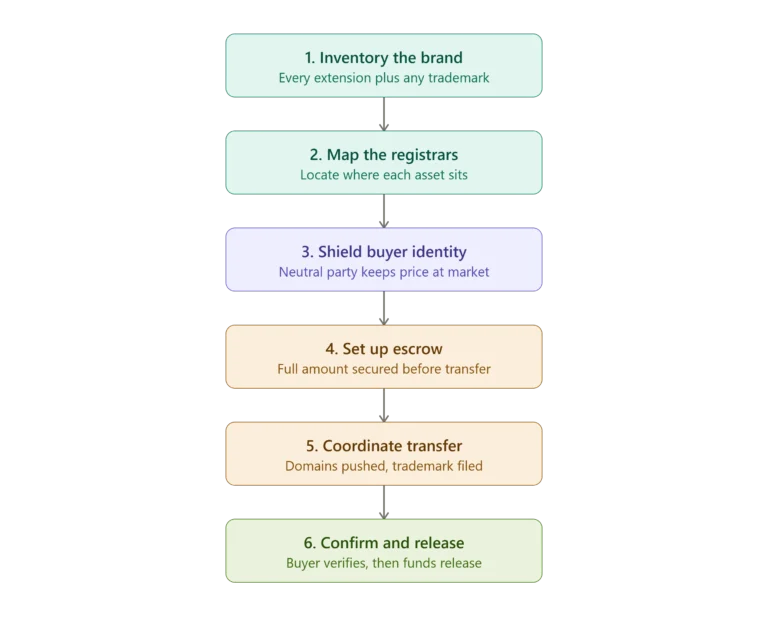
What an Anonymous Domain Acquisition Service Actually Does
There is a common misconception about buyer-side representation.
An anonymous domain acquisition service does not manipulate sellers, misrepresent the buyer’s intentions, or create artificial pressure.
Instead, a professional acquisition service will:
Remove identity-based pricing bias: Stripping away the “corporate tax.”
Prevent funding-related anchoring: Ensuring recent capital raises don’t dictate the floor price.
Isolate the negotiation: Separating the transaction from your corporate visibility and PR timeline.
Control information flow: Acting as a firewall between your executives and the seller.
When executed correctly, the seller negotiates strictly against the asset—not against your balance sheet.
When Anonymity Matters Most
You should strongly consider utilizing an acquisition partner to buy anonymously if you meet any of the following criteria:
You have recently raised capital: Public funding announcements are targets for price inflation.
You are in “stealth mode” pre-launch: Preventing competitors from discovering your brand name early.
You are undergoing a corporate rebrand: Where the domain is a critical dependency for the launch.
The domain is an exact match: If the domain is YourCompany.com, your leverage is naturally lower.
The seller is a professional: Portfolio holders negotiate daily; you need an equal expert on your side.
(Note: If you are simply securing a low-value domain for a weekend side project, professional anonymity is likely unnecessary. However, if you are securing long-term, critical brand infrastructure, identity neutrality is paramount.)
Why “I’ll Just Use a Gmail Account” Doesn’t Work
Many founders believe that sending an inquiry from a personal @gmail.com address is enough to buy a domain name anonymously. It almost never works against sophisticated sellers.
Experienced domain holders can easily:
Cross-reference the timing of your inquiry with recent trademark filings.
Track DNS activity and WHOIS history lookups.
Identify corporate IP behavior if you research the domain from your office network.
Connect seemingly unrelated corporate signals.
Buying digital assets intelligently requires technical structure. If you want to protect your leverage, the approach must be deliberate and shielded by a third party.
The Real Risk Isn’t Price. It’s Exposure. Most companies focus entirely on the final valuation. Few focus on the signaling that gets them there.
In domain negotiation, the very first email often determines the pricing ceiling. Once your identity is exposed to the seller, it cannot be reversed. The leverage is gone. That is exactly where an anonymous domain acquisition service changes the negotiation dynamic before it even begins.
Final Thought
Domains do not become expensive simply because they are rare. They become expensive because buyer leverage disappears.
Most leverage is lost in the first point of contact. If the domain matters to your business, you must control the conversation before it starts. Don’t let your public visibility inflate your valuation. Protect your position, and hire an expert before you negotiate.
FAQ
What is an anonymous domain acquisition service?
An anonymous domain acquisition service acts as a strict intermediary between a corporate buyer and a domain owner. The buyer’s identity, funding status, and strategic intent remain entirely undisclosed during the negotiation to preserve leverage and prevent price inflation.
Is it legal to buy a domain name anonymously?
Yes. Buying a domain name anonymously is entirely legal when conducted transparently as an agency relationship. An intermediary (like BuyerAxis) legally negotiates and acquires the asset on behalf of a principal buyer without disclosing their identity, transferring the asset privately upon completion.
Why would a seller increase the price after learning who I am?
Sellers often research funding rounds, company size, and perceived urgency. If they believe the domain is strategically critical to your company’s operations or upcoming rebrand, they will increase the price, effectively applying a “corporate tax.”
Does anonymity guarantee a lower price?
No, it does not guarantee a cheap price, but it prevents artificial markups. It preserves negotiation neutrality. The final price still depends on the asset’s inherent market value and seller expectations, but identity-based inflation (the stealth premium) is entirely removed.